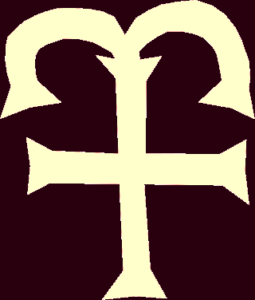
A beautiful 11th Century cross depicting figures still up for debate.
History

(Slovakia (dark green) in the EU (light green). From Wikipedia).
The oldest surviving archaeological artifacts from Slovakia, found near Nové Mesto nad Váhom, are dated to around 270,000 BC, in the Early Palaeolithic era. These ancient tools, made by the Clactonian technique, bear witness to the ancient habitation of Slovakia.
The first recorded tribes settled in the territory of modern Slovakia were Celts (from around 450 B.C.). The remains of Celtic oppida (elevated, fortified settlements) can be found in places such as Bratislava.
The Celts were forced out by the Germanic tribes (Marcomanni) which fought with the Roman Emperors Marcus Aurelius and Commodus (166 – 180 A.D.). Remains of the Limes Romanus (the fortifications on the Roman Empire’s northern border) are preserved in Slovakia (in Rusovce, Trenčín or Iža). The German tribes were driven out by Huns led by Attila.
Great Moravia arose around 830 A.D. when Moimír I unified the Slavic tribes settled north of the Danube. One lasting legacy from this time was the Glagolitic script and its successor Cyrillic, which is still used today. Saint Cyril was a Byzantine missionary from the First Bulgarian Empire, who, along with his brother Saint Methodius, created the Glagolitic script around 863 A.D. to spread Christianity among Slavic peoples. By around 1,000 A.D., Slovakia was part of the Kingdom of Hungary.
When the Austro-Hungarian empire was disbanded after WWI, Slovakia became part of Czechoslovakia. Following WWII, a USSR-backed communist coup established the country as a communist country. While not part of the USSR; Czechoslovakia remained an independent state but was a Soviet‑dominated satellite state from 1948 to 1989. In 1993, the country peacefully split into the Czech Republic and Slovakia.

(Slovakia is home to more castles per capita than anywhere else in the world. Pictured: Orava Castle, one of more than 180 in Slovakia, from LittleBigSlovakia.com).
Obverse

The obverse of the coin features the Slovak shield, with the date below, and the mintmark and designer’s initials at the bottom. The coin was produced at the Kremnica mint in Slovakia, which has been minting coins since 1328. The “Z” is for the designer Drahomír Zobek.
We covered the Slovak shield when looking at the Czechoslovakia 20 Haléřů.
Reverse

The reverse of the coin features a “Bronze cross (11th century A.D.) and value to the right”.
The modern Koruna, in use from 1993-2008, has 100 Halierov to 1 Koruna. This coin was minted for the full 15 years.
Mačany cross
The cross featured on the coin is the Mačany cross, which was found at the archaeological site of Mačianske vŕšky. It is actually a hanging metal case in the shape of a cross for storing relics, quotations from the Holy Scriptures, or fingers from the Holy Land. It is the oldest of all three known encolpions from Slovakia. All three come from this region
It is assumed that the Mačany cross has its origin in the Byzantine Empire, where it was made about in the middle of the 9th – 10th century, during the period of Great Moravia. It is currently in the deposit of the Homeland Museum in Galanta.
The cross is a Byzantine pectoral (known as enkolpia) – popular devotional objects spread over a vast area in Central and Eastern Europe, Black Sea region, and eastern Mediterranean. Within this, the Maèa cross has to be seen rather in the context of provincial workshops imitating elaborated pieces made of precious metals. The iconography should be read as a rudimentary and incomplete depiction of the Virgin Platytera (formerly Blacherniotissa) – a dogmatic type where the child Christ in a symbolic frame or medallion miraculously appears in front of the Virgin’s body with her acting as a suppliant. Due to the distance of main production centres and simple craftsmanship, the iconography could not been fully developed: additional flanking figures were left out to secure enough space for the representation of the Virgin.
Photos of the original artefact seem hard to come by, but here is a similar enkolpion cross found in Poland.
At the crucifixion of Jesus, Mary stood near the cross alongside other women and the beloved disciple. She is often pictured near the cross in art, though infrequently on the cross itself. This idea is that this cross depicts the three Mary’s at the cross. The other main likely explanation is that the cross depicts the Trinity. The Iconography of the Mača Cross is both simple and difficult to make a final determination on. What do you think? Let us know!

(Church of St Margaret of Antioch, from Spectator.sme.sk).
While the original church at Mačianske vŕšky (where the Mačany cross was found) is no longer standing, there are other very old churches in the country. The Church of St Margaret of Antioch, is the oldest church preserved in its almost original form in central Europe, stands outside the village of Kopčany, on the east bank of the Morava River accented by a single lime tree.
It dates to the 9th century, the times of Great Moravia. Its construction overlaps with building the Great Moravian fort Valy located across the Morava River near the Czech town of Mikulčice.
Who do you think the figures on the cross depict? What is your favourite ancient artefact shown on a coin? Do share your thoughts.
Leave a Reply